Showing posts with label Craft. Show all posts

Friday, April 15, 2011

Style Salvage Speaks to... 1205


As you all know both of us are interested in the interplay between the social constructs of masculinity with style and menswear. We have been meaning to discuss the relationship in a series of posts for some time now but however many posts we draft, we ultimately do not know quite where to begin. Thankfully a number of designers are posing and examining the questions for us and the resulting collections are full of variety and interest. With 1205 Paula Gerbase offers a unique concept of a functional unisex wardrobe – pieces for men and women that can be worn by either.

After graduating with a BA in Womenswear from Central Saint Martins she worked for Alistair Carr and Gareth Pugh before beginning her couture tailoring training on Savile Row with Hardy Amies and Kilgour. At Kilgour she began a long term collaboration with Carlo Brandelli. After five years working as Head Designer at Kilgour, Gerbase launched her own label 1205 with it's debut collection, 'One', due for s/s10. As a consequence of her menswear and couture training, quality of cut and fabric are paramount in Gerbase’s designs. The design process begins with fabric, looking at everything in a microscopic way, resulting in a unique, modern, almost clinical point of view. Earlier this week I was invited to see the debut capsule collection of menswear, womenswear and unisex pieces at her store/studio located at Kingly Court (Unit 1.3). Regardless of gender the collection showcases Gerbase’s trademark sensitive use of luxury fabrics and erudite pattern construction for a modern-contemporary muse. While admiring the collection I took the opportunity to sit down with the designer to discuss the label in more detail. Below we talk about how experiences at CSM, working with Alistair Carr and on Savile Row alike influenced her design aesthetic and take a closer look at her designs for SS11.

The shop front in Kingly Court.

Style Salvage: You graduated with a BA in womenswear from Central Saint Martins, as a student were your collections influenced by tailoring or did this evolve from your internships and through working with the likes of Carlo Brandelli at Kilgour?
Paula Gerbase: I actually started working with Carlo two years before I graduated. He needed a second person and he called Willie from Central Saint Martins and she recommended me because she knew I was keen to get in to tailoring and I ended up working alongside him practically full time during my final year. As for my final collection, it certainly had some tailoring influences but I used handmade lace from Brazil. So my tailoring influences were already there during my time as a student. I was interested in getting tailoring experience and learning how to make pieces correctly. I also worked with at Hardy Amies to really learn, they made me sit there and watch for some time before I was able to make anything.

Paula makes these origami leaves herself and I just love the subtle branding on the safety pins which are used instead of labels. With the 1205 pin, not only is it completely removable, but it can be placed anywhere the wearer likes. Paula loves the idea of the 1205 customer using the pin to add their own interpretation to the garments. It gives each piece a more personal aspect which is part of their ethos.

SS: You have worked with an amazing array of design talent. You worked with Alistair Carr and Gareth Pugh before beginning your couture tailoring training on Savile Row with Hardy Amies. From this, you went on to work at Kilgour - a move which let to a long term collaboration with then Creative Director Carlo Brandelli. What did these experiences teach you?
Paula Berbase: My main internship was with Alistair, it was here that I really got involved with the constructive side of things and then I realised that I wanted to get in to tailoring. This decision came at the right time because there was an opening at Kilgour. I started working there for only one day a week because he was unsure whether at first but then it slowly built up to a full time opportunity. So before I was full time at Kilgour, It was at this time that I was also working at Hardy Amies and I would work here for the rest of the week from nine until five. As my workload at Kilgour began to increase I did less and less at Hardy Amies. All of these experiences have really helped form my design aesthetic. At the beginning I could never have known that I would become so closely involved in tailoring but people have always told me that I can be quite severe, so in a way I knew tailoring would be right for me because of the way I think. it just fit. 1205 was a natural progression from what I had learned in pure tailoring and menswear and going back to my original passion.

I just love this silk Georgette scarf (available from oki-ni in addition to 1205 directly)

SS: We are always intrigued by numbers, tell us about the name...
Paula Gerbase: 1205 is simply the day I was born! Some people have asked me why I don't say 'Birthday' because they think it means the same thing but it doesn't ....your Birthday is a day that happens every year and usually means a party and lots of people calling you etc etc etc... A big fuss which I don't like! 'The day I was born' only happened once, and to me it signifies the beginning. A fresh start, which was what this project was supposed to be to me. Also, the reason I wanted to have only numbers is because of my slightly complicated history. Born in Brazil, German mom, Italian dad, traveling around with them during my life living in different places, learning different languages I wanted something that meant the same thing in all languages and everyone could in fact say in their own language so it became personal to each person. 'Douze - Zero - Cinq' in French or 'Tolv - Null - Fem' in Norwegian etc etc.

One of the real standout pieces from the collection is this tailored cardigan (available from oki-ni as well as 1205 directly).

SS: So that was the driving catalyst behind launching 1205?
Paula Gerbase: I certainly wanted to return to the more feminine side of things but to still keep my masculine element. The idea of a unisex wardrobe was very important to me. I think if something is well made and the fabric is great then it should not matter whose wearing it.

Lightweight 100% white linen summer shirt with a patch pocket, granddad collar and grey and cream mother of pearl buttons. Once again this is available from oki-ni as well as 1205


SS: So, in terms of your approach to design do you think of both body forms when designing...
Paula Gerbase: I guess that I take both in to account but my more menswear bits are quite feminine and my more feminine pieces are in some way masculine also...
SS: So your design approach is quite fluid. I think our ideas of what is masculine and feminine are always shifting anyway. Previously, especially coming from a tailoring background, a garment had to be made in a certain way
Paula Gerbase: Yes, completely. I'm not interested in the strict rules of tailoring as such. For example that a pocket needs to be in a specific place, or there at all in some cases. I understand what they are but I don't necessarily have to follow them.
SS: At the end of the day rules are always there to be broken or should at least be tested.
Paula Gerbase: It is quite freeing not having to follow them actually.

One of the rails in store, blurring the lines between the sexes.

SS: Are you conscious of pieces lending themselves more obviously to menswear or womenswear?
Paula Gerbase: I tend to see it as a collection over anything else. For the SS10 collection it is more feminine and for AW10 it is more masculine but the both just happened that way, both felt right. With the AW10 I took the decision to shoot it on a female model only because so many people have questioned the idea of a unisex piece and I wanted to surprise people and it will hopefully make people that bit more open. I like the idea that people might be confused a little at first because it means they are thinking about it. For me, it is great being able to play with fabric in a menswear way for women and it is nice to experiment in a womenswear way with cutting.
SS: I think that the concept and understanding of unisex clothing here is a little behind where it could and should be, when compared to other countries at least...
Paula Gerbase: I find it really surprising, I always thought people were more open minded. For AW10, if you see each piece you might assume that it is menswear but it can be worn extremely well by women also and I wanted to demonstrate that in the look book. Of course there are quite a few people like yourself who get it straight away, for others it might take a little time. I've just tried to push it because I feel it is right, at least for this. The reaction of journalists is always interesting. They are not quite sure where to put us really. They try to put collections in to boxes and we do not necessarily fit them. Buyers tend to place us in menswear but that is mainly because of my history. The customer is always more open to experiment with the pieces.

I was particularly taken with the prints. Paula photographed wool and blew them up to create them

SS: In terms of SS10, this is actually the first time I've seen it in person but the importance of prints and lightweight tailoring hits me straight off. What are the other themes running through to the collection?
Paula Gerbase: Comfort, playing with colour and mixing fabrics. For example using jersey and cotton in trousers, adding a jersey back makes them so much more comfortable. One of my favourite pieces is the tailored cardigan which is unstructured and hangs loosely with no fastening. It has shoulder pads but is extremely lightweight, it has piping but there is no fastening.
SS: At this point of the year I am always searching for my idea of a perfect Spring/Summer jacket and this is perfect. It is a wonderful example of relaxed tailoring.
Paula Gerbase: A formal jacket is great but this is so comfortable . I wanted to design pieces that could be thrown on. To still ensure that the wearer was dressed appropriately while the pieces feel so light. I enjoyed playing with jersey and cotton throughout the collection.


SS: One of the great things about having your own store like this one is that you can see how customers react to your clothes. Since the opening how have you enjoyed the experience?
Paula Gerbase: I've never had a store before but I enjoy it very much. As I'm always working here as well people were a little tentative coming in at first but it is quite odd for someone to be shopping in and around someones work environment. It is fun seeing people discover the store. Plus the set up of the store allows customers to ask questions about the pieces directly to me which is great. Initially we had more female customers because we opened without a number of pieces because we were still waiting on some of our garments to be made, as we produce everything in the UK it can take a little longer but since we've had all of our stock on sale and introduced a male mannequin to the display we've actually had more men coming in. I've been pleased by how guys have reacted to the collection. I love watching customers pick out pieces to try on without even asking me if they are meant for men or women. It makes me so happy because it proves that I'm on to something.

1205 Made in England

SS: You've mentioned that most of the production happens here in London. It is so refreshing to hear that because it is so rare...
Paula Gerbase: As much of it as possible takes place here in London. It just felt right. I love the idea of having a transparency in the way in which we work and this involves how our products are made. I enjoy working with craftsmen, I can spend hours talking to someone about a stitch or fabric construction and it is great being able to see them in London and to talk through pieces with them. They can give me suggestions, I'm not selfish in that way at all, in fact I enjoy bouncing ideas off with them.
SS: We have such a great history of tailoring here in London but it is seen as a dying trade in some quarters. So it is great to see a new brand embrace it, use it and to learn from these craftsmen.
Paula Gerbase: Definitely. I'll do a lot of the cutting but there are times where I'll have a question and I go back to cutters on Savile Row because those are the people that I know and we'll work on something. There are younger people coming through, whether or not they stay there depends upon the number of opportunities. It is great working with the mix of people drawn to Savile Row.

SS: And where are the fabrics sourced?
Paula Gerbase: They are English and Italian. I have really good relationships with certain mills that I worked with at Kilgour and I just really enjoyed working with them. I used to design the fabrics at the old place, it was nice to continue these relationships in a different way with this line.

In the middle of the shop floor is Paula's workstation and she let me take a quick peep at her beautiful sketches for SS11. Customers frequently ask her to sketch them something on the spot.

SS: How do you see brand evolving over the coming few seasons?
Paula Gerbase: One of the most obvious differences between menswear and womenswear collections is that womenswear can shift, swap and change with each season but menswear tends to be more gradual in its development and this is more attune to how I work. I want to push the idea of cut and playing with fabric and textures.
-------

Thursday, April 14, 2011

Replacing my bed for Bedouin

The table of Bedouin bags snapped me back in to a state of sartorial alertness.

For the past couple of days I have been walking around press days in a cloud of sickness induced apathy. Of course I have seen a great number of collections that would normally leave me open mouthed and clammy palmed but I found it difficult to become as excited as I really should do because when I've not been in bed I've longed to rest my weary head. I was soon snapped out of it though after I encountered Bedouin. Bedouin make well designed high quality bags that can snap any man back in to a state of sartorial alertness. Every aspect of their leather creations is thought through in extreme detail. The bags are hand made in England, using a level of craftsmanship and attention to detail that English luggage makers are known and admired for. The bags are inspired by traditional craft, geometric art, the macabre and surrealism and are designed for comfort and durability.


An everyday bag, ideal for the daily commute and will fit all your daily essentials comfortably.

In addition to being hand crafted in England, the very best of materials are sourced from across Europe. Fabrics are sourced from the best British suppliers for their quality, durability and feel. The leathers are European or British and are naturally tanned using vegetable tanning agents. Stitching is of the highest quality and weight. Each is made with waterproof waxed cotton or canvas (120z Rhinowax is used for the tote and messenger) and designed with the specific function fully in mind. The hardware on the bags is sourced from the best engineering companies, zippers are from Switzerland and the Cobra buckles are forged in Austria and are noted for being the worlds strongest buckle.

The Mamluke - a great weekend away bag or a larger daily bag.

What sets these bags apart is that they are beautifully made and perfectly proportioned for each use. The Mamluke overnight bag, the Barbary messenger bag, the Janissary laptop bag and the Medina tote are all fit for purpose, like any good piece of design. These bags will certainly protect your belongings. At Bedouin they believe in quality and each purchase should last a lifetime. They do not believe in disposable fashion and an endless replacement cycle; buy quality and buy it once. They are extremely confident of the quality and workmanship of their bags, which is why they offer a lifetime guarantee on materials and workmanship from normal wear and tear. Everything is cut by hand and then stitched on a couple of heavyweight machines, there are no shortcuts taken in the creation of these bags.

The new look Medina tote bag particularly caught my eye.

You might have seen a well written piece in the new and improved fashion section of the Times this morning (available to view online here). In the well written piece that saw the stylist examine the handbag fixation he was forced to declare that "this (Bedouin) newly launched hand made in England brand has done for me what the Alexa and Hillier are doing for my lady friends." To put it simply he had found a collection of bags that he would happily parade around town regardless of whether they were empty or not and confessed that he now needs one in every colour. After seeing the bags up close I can certainly see where he was coming from.

Update:
I have just seen another great piece on Bedouin over on Gentleman's Corner. Via this piece I learnt that the brand is headed up by Silas Grant, a CSM graduate and ex senior design specialist at Nokia. Grant says, “In my opinion, selling a bad product on the prestige of your brand is a short term strategy, and not sustainable for the long term. Classic quality never goes out of fashion. I keep the prices really tight at Bedouin, but quality does cost more. Buy quality and buy it once”.

The Barbary - a large capacity professional Courier Bag designed to fit the body, contract and expand depending on the load being carried.

Bedouin base the design of each bag on the metaphor of the Bedouin tent. A nomadic shelter, rugged and weatherproof on the outside, whereas inside they offer luxury, shelter and comfort. Their bags follow the same metaphor, rugged and durable on the outside, dust proof and water resistant. Inside, printed linings and padded compartments provide secure storage for any personal possessions. I personally love the addition of the distinctive and macabre illustrations that decorate each of the bags interior cotton linings. These are far from your typical 'manbags' and I'm pleased that I swapped my bed for Bedouin.

A look inside the Barbary.

Style Salvage Speaks to... Oliver Spencer


Oliver Spencer founded his eponymous label in 2002 and has always made clothing that is seen rather than heard. Oli wanted a collection that mirrored his own wardrobe; a bridge between popular street wear and traditional tailoring. He approaches everything from a luxury standpoint but then injects functionality to create collections that combine classic English style with hints of Americana and Japanese ideas to consistently dish out a modern sophisticated aesthetic. Quality fabrics. Modern fits. Old school construction. Characteristic details. Exquisite craftsmanship. This recipe remains today. It is undeniably a modern British brand. More than half the line is made in the UK and while striving for quality Oli sources the fabrics and buttons before overseeing how it's all sewn. So, when we were invited to pop down to the flagship store on Lamb's Conduit Street to see the store and to speak with Oli we jumped at the chance. We've said many times on the blog that strolling down this special street in Bloomsbury feels like a little retail reconnaissance and Oliver Spencer has played no small part in that. Here we learn more about the evolution of the brand from Favourbrook, the community spirit of Lamb's Conduit Street, the importance of craft and manufacture and how Oli sees the brand evolving over the next few years...

The inviting store front on Lamb's Conduit Street.

SS: How did it all start for you? What were your inspirations, your dreams and the driving catalyst behind Oliver Spencer?
Oliver Spencer: It all started with some corduroy suits. I was doing more and more work for our other label Favourbrook that was becoming more and more luxe utilitarian/casual. I like the whole un-constructed thing. At that time a dark brown corduroy suit washed, unstructured was a big turning point for me. I wore it virtually every day.


SS: Aside from it being your name, what does Oliver Spencer mean to you?
Oliver Spencer: It’s Englishness. I am lucky enough to have two interesting straight forward names, I think it tends to stick in peoples heads, at least we would like to hope so! Otherwise I still find it a bit weird!


SS: When you founded the label back in 2002 you wanted a collection that mirrored your own wardrobe; a bridge between popular streetwear and tailoring. Does this recipe still remain? How has the label evolved over the years?
Oliver Spencer: Yes this recipe does still remain. I still make everything for myself. Colour has been the main influence going forward, primary colours are a big area in menswear.

SS: What were the first and last item you remember designing?
Oliver Spencer: First item was a waistcoat. The last was a cardigan.


SS: Craft and local manufacture are obviously very important to you as over half the line is made here in the UK. You must work with some extremely small and remote factories. Is it difficult to find them and how has your relationships grown over the years?
Oliver Spencer: No it is not difficult to find the factories, you just need to know how. Most of the factories that we work with, we have developed so they work to within our specifications. The main one that we use is an ex Burberry factory, so they have all the tools and the experience for the job. We love making in the UK.


SS: Now on to your wonderful store. Lambs Conduit Street (as profiled by Monocle last year) shows what can be achieved in retail areas as it champions a real community spirit. Whenever I speak to brands looking for a premises of their own they often dream about this stretch of Bloomsbury. How easy was it to come by? And what, do you think, makes the street so special?
Oliver Spencer: The street has great community in it, with a mix of local and professional, generally very open minded people. Key to the whole mix is three or four great pubs, which means it is a good place to go out at night too. My friend Cathal from Folk introduced me to the street and I have never looked back.


SS: What are your favourite pieces in store at the moment?
Oliver Spencer: Chukka Boots in blue suede with a white sole. Tennyson Red Navigator Jacket.

SS: How has the menswear landscape changed since you launched the label? What excites you about the future of menswear?
Oliver Spencer: Sorry to bang on about it but colour! This is the way forward for menswear. We have become more casual in the right way over the years and we use a lot of detailing. Our mantle is to be seen and not heard.


SS: Collaborations are a key facet of the brand. During the last couple of weeks we've seen the unveiling of your travel shirt with Monocle and your capsule shoe collection for Topman. What have been your favourite collaborations to date? Who would you love to work with in the future?
Oliver Spencer: For me collaborations at the beginning were brought to mind for Junya Watanabe for Commes des Garcons. Future collaborations, I have to think carefully about this as we get approached a lot and it is important that brand synergy is on the same playing field. All I can say is it will definitely be an English brand.


SS: How do you see the brand developing over the next few years?
Oliver Spencer: Footwear will develop for us. Accessories, bags and trousers I believe will be the main growth area.

SS: Finally, would you be able to share a few address book recommendation to our readers which we will duly add to our map...
Oliver Spencer: Badlams Hairdresser’s on 37 Lambs Conduit Street (Bloomsbury, London WC1N 3NG). The Espresso Room on Great Ormond Street (31-35 Great Ormond Street, London WC1N 3HZ) and Café Gitan in New York.

------
If you are ever in and around Bloomsbury you just have to stroll down Lamb's Conduit Street and pop in Oliver Spencer.

Tuesday, April 12, 2011

Albam AW10

We might not have reached mid August yet but my sweaty, aching limbs are longing to be protected by soft, texture rich fabrics as the hot, stagnant air is replaced with something a little more fresh and biting. During the press day madness back in April I encountered a dream rail of autumnal essentials at Cube. For AW10, Albam have gone back to their starting principle of creating the essential items within a man’s wardrobe, from the classic white t-shirt, through to the Italian made suit and an English crafted Pea Coat and from August to December, each month will see a capsule collection dropped into store. The first of which is imminent and to provoke a little excitement the guys posted the first batch of look book images over on their 'Behind the Scenes' blog.

Shawl collar knit. A perennial brand favourite

Knitwear is produced by a factory for which this AW10 collection will sadly be the last collection they make. The focus is on pieces inspired by the factory’s archive which counts the 1980’s America’s cup yacht team, the military and the Royal family as customers. Styles include the ‘Submariner’ roll neck and the shawl collar cardigan (a perennial favourite of Albam).
Each piece, when released, will be a numbered piece of one hundred produced.

Artisan waistcoat and chambray shirt.

The Albam signature of white details has been revisited to make them more integral to the garment itself. Highlights of this are seen in the linking of the knitwear in ecru yarn, only visible when the garment is opened up. This can also be seen in the taped seam garments creating an internal framework to the pieces.

Artisan pea coat.

Outerwear has become a focus of Albam since the release of the Fisherman’s Cagoule in 2007. Key pieces include the Workwear Jacket in a bonded cotton weave with polar fleece on the inside, which gives a more structured garment whilst being light and warm. Wax fabric also remains key with a workwear style that is crafted from wax cloth as a lightweight casual rain jacket and a Pea Coat, made from an oiled duck canvas from the USA.

Trail parka

The key pieces that embody the ‘Modern Crafted Clothing’ concept are the taped Ventile styles of the Alpine Jacket and Rain Mac. Designed and crafted in England these are waterproof garments, which combine Albam’s love of the outdoors with the forgotten expertise of one of the factories used.

Ventile mac and backpack.

This is just a handful of the styles that are coming through this winter at Albam. Throughout the ‘Essentials’ the styles remain cleanly designed with a focus on fabrication and construction. A number of the developments have arisen following discussions with customers about what they are wanting and where they themselves want to go with things. I love how the guys have remained true to their founding concept, slowly developing and growing their range all the while letting the right customers find them. I'm looking in stocking up on a few new season essentials.

The return of Joe Casely-Hayford for John Lewis

hat better way to start your Friday than to receive a fright from Sibling before the facilitation of further excitement with the news of the return of Joe Casely-Hayford for John Lewis for AW10. What more, the collection is soon to hit shop floors and has doubled in size from its preceding SS10 range. The sophomore collection of this intriguing collaboration once again celebrates true craftsmanship and home grown British manufacturing. With collaborations with remote mills in Yorkshire, tartan experts in Selkirk and respected bag maker Chapman to name but a few, the collection once again brings seemingly specialist products to a wider audience without losing any of the integrity that make their products special. The High Street just got that bit more interesting...


"Our Aw10 collection draws influence from a celebrated group of 20th century British artists, a number of whom were members of the famous St Ives Artist Colony set up in 1928. Our clothes have inherited the strong spirit of this movement and adopted the sculptor Henry Moore's idea of continuity and endurance, words which embody the ethos of this project"
Joe Casely Hayford

The debut thirty piece capsule collection for SS10 celebrated the best of authentic British design while providing a complete wardrobe, encompassing everything from jackets to shoes. It was, not surprisingly, extremely well received. AW10 sees Casely-Hayford build upon this concept of collaboration with the finest British manufacturers to crate a range of future classic designs. Following the success of last season's partnership with Barbour, the new collection includes a winter version of the extremely popular Bezique semi tailored blazer (which I of course nabbed for myself last season), and the introduction of a unique waxed cotton and Melton padded Pea Coat (as shown above). Simply stunning. With over fifty pieces in the collection and prices ranging from £60 to £400 ther really is something for every man.


The new collection sees the introduction of two key seasonal overcoats, the Pallas and the Paris. Both are derived from the classic Chesterfield Topcoat. Both are reinventions of a stalwart of a true Englishman's wardrobe. The Pallas is crafted from coarse Marling and Evans Melange tweed and has a lightweight quilted body, giving it an otherwise formal topcoat a unique and contemporary sporty twist. Meanwhile, the Paris continues the Chesterfield theme but includes new features including dropped shoulders and a matching lightweight, padded zip out gilet. The cloth has been exclusively developed and woven by the Abraham Moon mill in Yorkshire. If all that wasn't exciting enough, the season sees Joe Casely-Hayford launch his first exclusively crafted suit for the High Street. Utilising a transeasonal super 130s Savile Clifford travel worsted cloth the suit will be something every man should have hanging in his wardrobe.


The increased collection size has enabled Casely-Hayford to expand the range of accessories on offer to include two new satchels developed with the respected bag maker Chapman, who is one of only a handful heritage luggage manufacturers still producing entirely in the UK. Through joining forces with the tartan experts Lochcarron of Selkirk, Casely-Hayford has designed two new bold check lambswool and cashmere mix scarves. Regular readers will remember the effect that last seasons Pukk leather brogues had on me. Made by Cheaney, the beautiful brogues captured my imagination the moment I saw them, this seasons incarnation have had the same affect on me. The Mentor shoe, a new take on the classic Oxford, uses sophisticated design elements including an integral punched toe cap and a chamfered Goodyear Welted sole to make a shoe both wonderfully stylish yet practical. The Mentor is from Cheaney and is once again produced using traditional methods by Northampton craftsmen. Earlier this week I was fortunate enough to be invited to their Desborough factory to watch the final batch of shoes being crafted. It was an amazing experience and I'll be posting an in depth feature on the processes involved early next week. Keep your eyes peeled!

Veja Indigenos and new methods of work

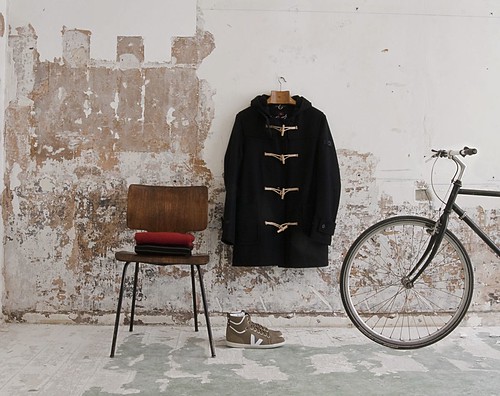
Veja Indigenos Hi Top

As I found out in March, Kapok in Hong Kong is a store that only stocks brands that combine design with craftsmanship. However, many of the products go even further, introducing social and environmental issues to the mix. This was no more apparent than with trainer brand Veja. They are considered by many to be the green sneakers and rightly so but they are much more than that. I have to be honest with you, when I hear the words eco friendly my mind is filled with thoughts of clumpy hemp or folksy printed creations but fortunately Veja have a different proposition. The label was set up in 2003 by two Frenchmen determined to fight worldwide deforestation, exhaustion of natural resources and Labour exploitation. They have managed to come up with one of the best looking fair trade products I've ever come across, none more so than the Indigenos range for AW10...


These low and hi tops are made with suede that is tanned without heavy metals or chromium with soles made with wild rubber from the Amazon.

Kapok's owner, Arnault assured me that they are both stylish and comfortable while ensuring your conscience is clean. When I returned from Hong Kong I was keen to learn more about the brand. However, before I could even draft a desperate email to their press department I had an email waiting for me in my inbox inviting me to their new London showroom. So, last week I popped down to see them to find out as much as I could about the brand. What struck me straight off was the close knit nature of the team (the London office has only three staff) and how they let the products do the talking for them. You won't see any fairtrade labels pasted on to any of their products. Veja has created a global chain that emphasises solidarity and the environment ranging from their small producers in Brazil to the European concept stores that we are all more familiar with. The brand works directly with Brazilian small producers, who are organized into cooperatives, of organic cotton and natural latex from the Amazon. The girls at Veja showed me the below video which really helped me understand how models are made. Right from tapping rubber in the Amazonian rainforest to picking organic cotton, following them to the assembling factory in Porto Alegra before being shipped off to France...


Veja produce simple, low profile trainers produced to a very high quality. With organic cotton from the Northeast of Brazil, wild Amazonian rubber and ecological leather, it is inventing new methods of work while still creating trainers with designs to get excited over.

Monday, April 11, 2011

Style Salvage Speaks to...French & English Confectioner's


The wonderfully named shoe and accessories label French & English Confectioner's first came to our attention after one one of its breathtakingly beautiful, hand made patent leather rucksacks was included as one of Fantastic Man's daily recommendations. Since the 18th May we caught sight of it once again during Nathalie Tunna's GFW show and have subsequently attempted to find out as much information about the craftslady behind it all, Cordwainer trained designer Lucie Gonnord. Gonnord's shoe obsession, which began at the age of five with her school sandals, combined with career twists and turns through animation and t-shirt design, culminated in a decision to create one-off and limited edition shoes and bags. All of F&EC's designs are expertly handmade in London. The ever-evolving collection, inspired by the simple designs of a 1970's childhood and a love for all things pop is a sophisticated distraction from the throwaway fashion of the high street. The tradition of hand-making shoes has all but died out in this country but Gonnord uses old equipment and vintage lasts to help keep the tradition alive. Here we talk to the designer about her creations and are allowed a rare glimpse of her secret London workshop...

A look around Lucie Gonnord's workshop...

SS: What were your inspiration, your dreams, and the driving catalyst behind French & English Confectioner's?
Lucie Gonnord: After studying shoemaking at Cordwainers, I started to develop an idea for a design label that would enable me to hand-make my designs. Making is as important to me as designing. Sitting in an office designing for someone else has never appealed to me.

I wanted to continue the tradition of hand-making shoes which has all but died out in this country, and use old equipment and lasts. Making shoes is a very time-consuming process, with little financial reward. You have to do it for love! Making bags too has helped me create a more viable business.

SS: What does French & English Confectioner's mean to you?
Lucie Gonnord: An old sign painted with the words French & English Confectioner’s was revealed during a shop refit opposite my boyfriend’s work in Tufnell Park. He’s a chef and wanted to use the name for his restaurant. After a bit of persuasion, he very kindly gave the name to me, as it fit so well with my ideas. For my website I wanted to create the atmosphere of an old-fashioned shop, and I’m half English, half French. I found out later that the definition of a confection also used to apply to a shoe. I asked a local who had grown up in the area, and he remembered the shop and the jars of sweets in the window.

Hand stitching

SS: What were the first and last item you remember designing?
Lucie Gonnord:The first item I designed for F&EC’s was a pair of women’s shoes, inspired by the Roxy Music song Virginia Plain. They were navy blue 5in platform Mary-Janes with a cream frill down the side, and only came in one size. I didn’t sell any!


I’m currently working on women’s t-bar sandals with a hand-stitched sole. I’ve never made shoes this way before (I normally glue the soles), so it will be a challenge. I love stitching by hand, and this is a traditional technique in shoemaking. I’m beginning to incorporate hand-stitching into some of my bag designs too.

SS: As all of your designs are expertly handmade in London, craft and local manufacture are obviously very important to you. Can you talk us through some of the process involved in creating your bags? What can you tell us about the workshop?
Lucie Gonnord: After making the pattern, which takes a lot of time and thought, I cut the leather by hand and prepare all the straps, fittings and buckles. I skive (make thinner) the leather for trims by hand. I sew everything on my 1930’s machine, which has a post bed especially made for shoemaking. It’s a bit of a beast and unbelievably heavy, but still works really well. Then I fit all the eyelets and rivets.

A closer look at the craftsmanship of the rucksack

SS: Could you talk us through your current range of bags for men and the inspiration for each?
Lucie Gonnord: I designed a music case, inspired by one that my brother had as a kid. It was vintage even then, and had J. Arrowsmith scrawled in ink on the inside, so I named it after that. It’s perfect for carrying a laptop in.

The patent leather rucksack was specifically designed for men, but works well as a unisex piece. It’s based on the classic canvas rucksack you used to see everywhere in the 70s, but can’t get anywhere now. The two-tone patent gives it a modern reworking.

The weekend bag was the design that started me making bags. I was going to Paris for the weekend and didn’t have any chic luggage! I then made one for my friend, Stephen, who cycles everywhere. He was impressed that he could fit and carry four bottles of Prosecco in it! It also works well as an everyday bag. I still use mine all the time. Making it made me realise that bags could be a good addition to my designs.

The Arrowsmith, Tote and Messenger

SS: The website informs us that men's shoes will soon be available. As a self confessed shoe obsessive, what would you like to see on men's feet? What does the new collection look like?
Lucie Gonnord: I only use vintage lasts for my shoe designs, as I want to re-use old equipment rather than buying new. I’m still looking for a set of men’s lasts, it’s difficult to find a full size run, but as soon as I do I will design a small collection for men. Most of my designs are re-workings of old classics, so I’d like to make simple, wearable shoes, which hopefully will be unique and interesting, but not over-designed.

I like the fact that more men are now wearing proper shoes, like Church’s, and getting away from trainers. I also have a hatred of flip-flops, so a nice, smart covering of the feet always makes me happy!

Designing for men is always a challenge, finding the balance between something interesting and something men actually want to wear.

SS: Is there an item of clothing or accessory that you’d like to see more men wear?
Lucie Gonnord: It’s nice to see more men wearing smart, classic accessories and coats, and investing in pieces that will last. I prefer stylish to fashionable, especially on men.

The patent leather rucksack in all its beauty.

SS: If you could go back in time and experience any moment in style, what would it be?
Lucie Gonnord: The 1930s and 40s, when all men wore hats! And people looked after and repaired their clothes and shoes. People seemed generally to be more well-groomed then. Now it’s so easy to run around in jeans and trainers, I’m the worst for it when I’m busy, so I really admire people who make the effort to look dapper.

SS: Finally, how do you see French & English Confectioner's developing over the next few years?
Lucie Gonnord: First of all, I want to build up the business to a point where I don’t have to work as well! My aim was always to make an OK living out of it, but it takes a lot of time and hard work to feel secure enough to take the leap.

Building up the label online is my first priority. Then hopefully I’d like to open a shop/workshop. If you’re paying for somewhere to work, it makes sense to be able to sell from it as well. I also think it’s good for people to see things being made.

When I have more time, I’d like to start making more shoes again. Taking on apprentices is something I want to do in the future.

The 1930s machine in action

Saturday, April 9, 2011

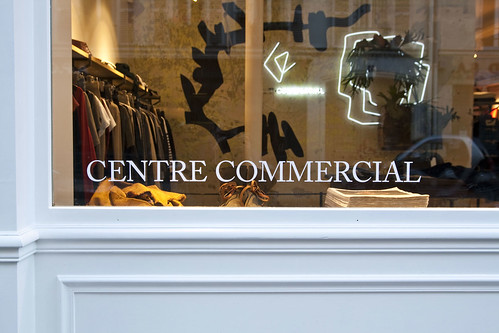
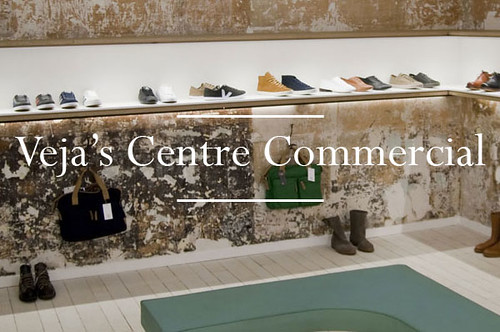
Veja's Centre Commercial


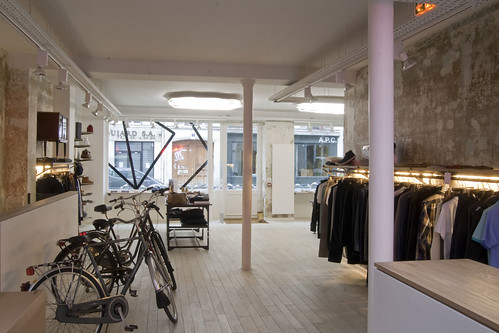
The two founders of Veja have embarked on an intriguing retail project located in a neighbourhood that favours slow shopping, a few steps away from the Saint Martin Canal, and its cafés, and terraces. The space is a natural extension of the values behind the label and combines fashion with social commitment and artistic projects with environmental concerns. For those of you unfamiliar with the label, the origin of the Veja project can be summed up in one question: is another world possible? 

Over the last six years Veja have helped put forward their answer by creating a global chain that emphasises solidarity and the environment, from the small producers in Brazil to the European concept stores that sell its growing product range. Centre commercial offers labels made in France, Great Britain and Denmark and houses second-hand bicycles, vintage furniture and art works. It is a collective space, uniting local, social and environmental initiatives. The retail space showcases their varied but ultimately complimentary influences. Here we speak with Veja's Aurélie Dumont to learn more about the store and the brands plan for the future. 


SS: Centre Commercial instantly feels likes the antidote to fast paced retail. Was this one of the driving catalyst for the project?
Aurélie Dumont: Yes, Centre Commercial has been thought of as a place to slow down.  Reminiscent in the ways of our grandparents, we wanted to favour know-how and continuity. Rather than mere products, Centre Commercial will curate genuine projects.

SS: How did the project arise, was it always part of the Veja plan, if not how did it evolve?
Aurélie Dumont: Veja was created in 2004 with the intention of proving that it is possible to work differently. We have created a strong social, economic and, ecological chain from small producers in Brazil to the doors of European stores. During these past two years we have started adding a cultural dimension to Veja having been inspired by people we have met along the way: designers with really great projects going far beyond the ecology or meeting artists with fascinating messages. We started organising art exhibitions and a series of unconventional talks, and we soon felt that we needed a space to feature those messages.

Centre Commercial is meant to be a place to slow down and to question what we consume through a selection of locally made clothes and accessories, furniture sourced by antique dealers, committed installations and artistic projects, bicycles revamped by a social charity and shortlisted books and publications.

SS: What does Centre Commercial mean to you?
Aurélie Dumont: In a way, the name itself refers to mass consumption. The name is a nod to the works of the French philosopher Bernard Stiegler and suggests questioning our consumption habits. Centre Commercial is a shopping center. A selection of clothes, accessories, furniture, bikes, cosmetics, books and publications has been put together…. a shopping center then …but modeled after us. 

SS: Like the Veja label itself, the space manages to combine fashion with social commitment and artistic projects with environmental concerns. It is a space infused by your varied but ultimately complimentary influences. How did you curate the store?
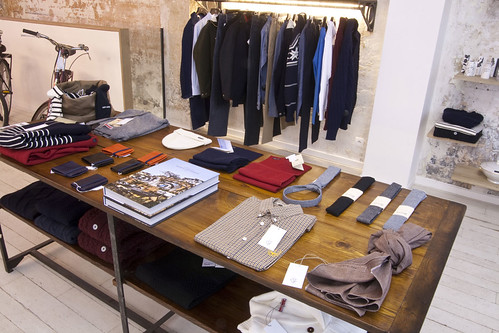
Aurélie Dumont: Centre Commercial is meant to be a place to slow down and to question what we consume through a selection of locally made clothes and accessories, furniture sourced by antique dealers, committed installations and artistic projects, bicycles revamped by a social charity and shortlisted books and publications.  Among the selected wardrobe for both men and women you will find brands such as Knowledge Cotton Apparel whose shirts are crafted in Denmark using organic cotton, Saint James who has been knitting their fisherman style jumpers in Brittany since the 1950’s or La Botte Guardiane whose boots and shoes are hand-made in the French Camargue following traditional methods.

An enticing mix of product from labels made in France, Great Britain and Denmark.

SS: Centre Commercial offers labels made in France, Great Britain and Denmark whilst housing second-hand bicycles, vintage furniture and art works. Are the brands and individuals involved friends of Veja? How did you find the right mix of products?
Aurélie Dumont: Our ambition was to create a space which would work as a catalyst for projects and initiatives we like.  Ties between those projects will probably arise where we don’t expect them.  From fine artists to fair trade certification bodies, we will feature individuals and companies which work differently.

Veja and Gloverall

SS: Would you be able to talk us through some of your favourite products currently in store?
Aurélie Dumont: One of the most interesting discoveries so far has been the quarterly French XXI publication. XXI features seasoned novelists, recognized investigative journalists and major graphic novelists depicting our current world through well-documented and in-depth articles. Both the latest issue and the 11 back issues are available at Centre Commercial.

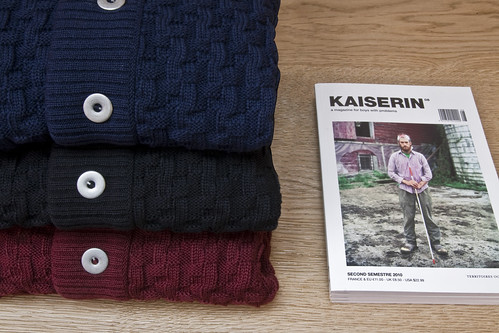
SNS Herning knits

SS: Aside from fabulous product, what do you hope the consumer will take away from the store?
Aurélie Dumont: We hope that they will take away the feeling that trade can be done in a different way while experiencing a certain aesthetic. Centre Commercial aims to be a place where minds can meet. The book selection for example, contrary to what is on offer in a traditional library, counts only ten books in total. These have been carefully chosen by a French editor, they are his current selection of great books he’d like to share. That selection will be periodically renewed by each new literary specialist.

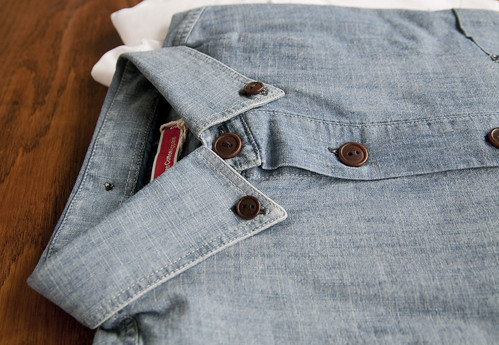
Knowledge Cotton Apparel whose shirts are crafted in Denmark using organic cotton


SS: The store sounds far from static, the curation of product and art is an on going endeavor. How would you like to see the store evolve? Is there anything that you are particularly looking forward to in the near future (for example a particular delivery of product or upcoming exhibition?
Aurélie Dumont: Centre Commercial opened last week featuring the fine artist Kleber Matheus from São Paulo, whose works are made from neon light tubes. More exhibitions will be unveiled in 2011. For the coming months we will have more ‘made in France’ garments, some promising accessories and a new exciting project around bikes.


Centre Commercial aims to slow down the retail experience.

SS: Finally, what's next for Veja?  
Aurélie Dumont: 2010 has seen the launch of Projet Numero Deux, our debut line of day bags and accessories in collaboration with London-based store Darkroom and the exclusive web platform oki-ni.com. Vegetable tanned-leather wallets and laptop sleeves made of organic cotton have just been released. For 2011 we have worked on new exciting styles and an exclusive collaboration with French Trotters which will be soon uncovered!

Centre Commercial is located at 2 Rue de Marseille in Paris.