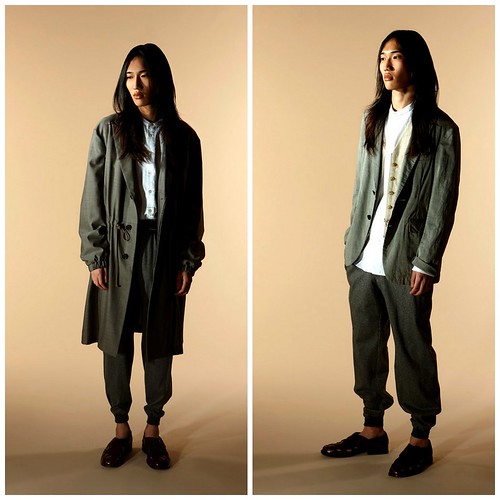
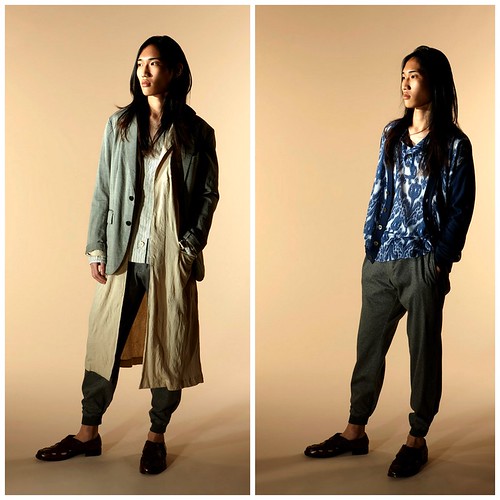
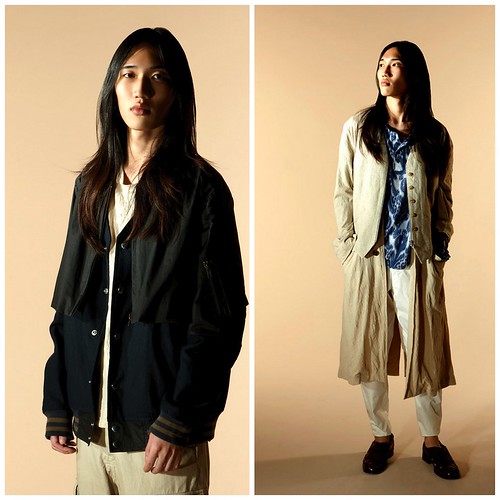
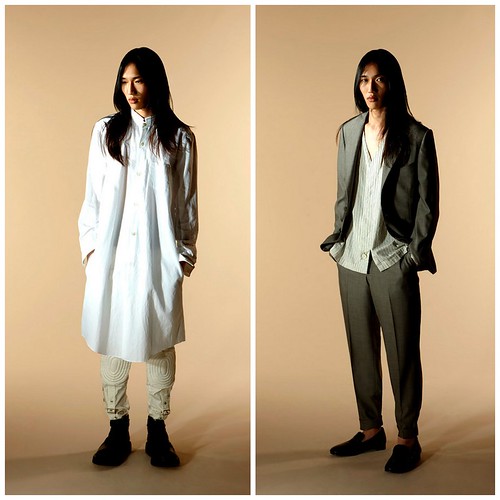
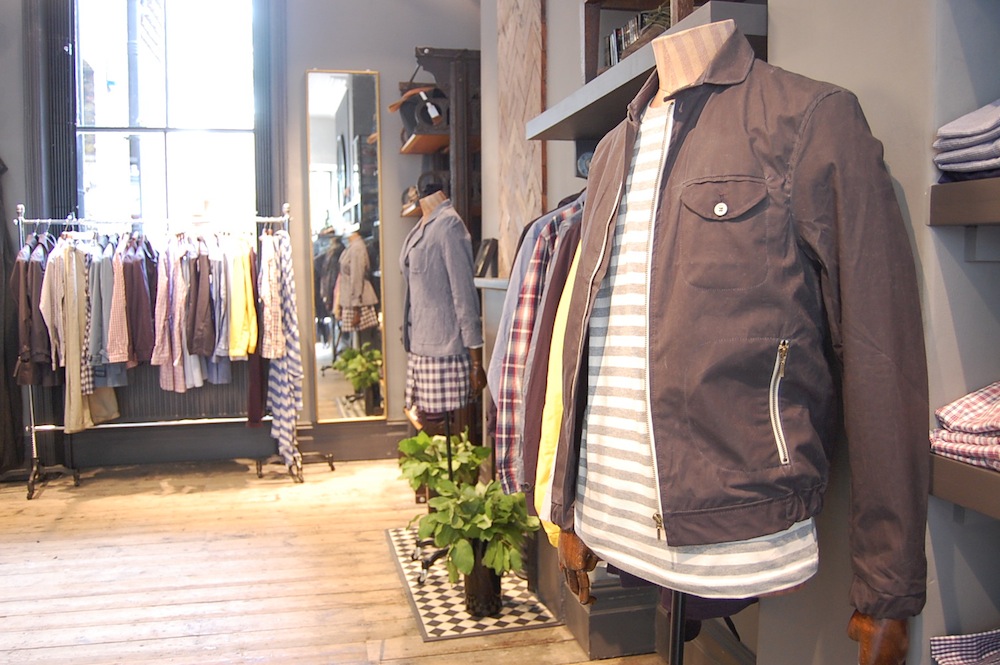
As you all know both of us are interested in the interplay between the social constructs of masculinity with style and menswear. We have been meaning to discuss the relationship in a series of posts for some time now but however many posts we draft, we ultimately do not know quite where to begin. Thankfully a number of designers are posing and examining the questions for us and the resulting collections are full of variety and interest. With 1205 Paula Gerbase offers a unique concept of a functional unisex wardrobe – pieces for men and women that can be worn by either.
After graduating with a BA in Womenswear from Central Saint Martins she worked for Alistair Carr and Gareth Pugh before beginning her couture tailoring training on Savile Row with Hardy Amies and Kilgour. At Kilgour she began a long term collaboration with Carlo Brandelli. After five years working as Head Designer at Kilgour, Gerbase launched her own label 1205 with it's debut collection, 'One', due for s/s10. As a consequence of her menswear and couture training, quality of cut and fabric are paramount in Gerbase’s designs. The design process begins with fabric, looking at everything in a microscopic way, resulting in a unique, modern, almost clinical point of view. Earlier this week I was invited to see the debut capsule collection of menswear, womenswear and unisex pieces at her store/studio located at Kingly Court (Unit 1.3). Regardless of gender the collection showcases Gerbase’s trademark sensitive use of luxury fabrics and erudite pattern construction for a modern-contemporary muse. While admiring the collection I took the opportunity to sit down with the designer to discuss the label in more detail. Below we talk about how experiences at CSM, working with Alistair Carr and on Savile Row alike influenced her design aesthetic and take a closer look at her designs for SS11.
 The shop front in Kingly Court.
Style Salvage: You graduated with a BA in womenswear from Central Saint Martins, as a student were your collections influenced by tailoring or did this evolve from your internships and through working with the likes of Carlo Brandelli at Kilgour?
Paula Gerbase: I actually started working with Carlo two years before I graduated. He needed a second person and he called Willie from Central Saint Martins and she recommended me because she knew I was keen to get in to tailoring and I ended up working alongside him practically full time during my final year. As for my final collection, it certainly had some tailoring influences but I used handmade lace from Brazil. So my tailoring influences were already there during my time as a student. I was interested in getting tailoring experience and learning how to make pieces correctly. I also worked with at Hardy Amies to really learn, they made me sit there and watch for some time before I was able to make anything.
Paula Gerbase: I actually started working with Carlo two years before I graduated. He needed a second person and he called Willie from Central Saint Martins and she recommended me because she knew I was keen to get in to tailoring and I ended up working alongside him practically full time during my final year. As for my final collection, it certainly had some tailoring influences but I used handmade lace from Brazil. So my tailoring influences were already there during my time as a student. I was interested in getting tailoring experience and learning how to make pieces correctly. I also worked with at Hardy Amies to really learn, they made me sit there and watch for some time before I was able to make anything.
 Paula makes these origami leaves herself and I just love the subtle branding on the safety pins which are used instead of labels. With the 1205 pin, not only is it completely removable, but it can be placed anywhere the wearer likes. Paula loves the idea of the 1205 customer using the pin to add their own interpretation to the garments. It gives each piece a more personal aspect which is part of their ethos.
 SS: You have worked with an amazing array of design talent. You worked with Alistair Carr and Gareth Pugh before beginning your couture tailoring training on Savile Row with Hardy Amies. From this, you went on to work at Kilgour - a move which let to a long term collaboration with then Creative Director Carlo Brandelli. What did these experiences teach you?
Paula Berbase: My main internship was with Alistair, it was here that I really got involved with the constructive side of things and then I realised that I wanted to get in to tailoring. This decision came at the right time because there was an opening at Kilgour. I started working there for only one day a week because he was unsure whether at first but then it slowly built up to a full time opportunity. So before I was full time at Kilgour, It was at this time that I was also working at Hardy Amies and I would work here for the rest of the week from nine until five. As my workload at Kilgour began to increase I did less and less at Hardy Amies. All of these experiences have really helped form my design aesthetic. At the beginning I could never have known that I would become so closely involved in tailoring but people have always told me that I can be quite severe, so in a way I knew tailoring would be right for me because of the way I think. it just fit. 1205 was a natural progression from what I had learned in pure tailoring and menswear and going back to my original passion.
Paula Berbase: My main internship was with Alistair, it was here that I really got involved with the constructive side of things and then I realised that I wanted to get in to tailoring. This decision came at the right time because there was an opening at Kilgour. I started working there for only one day a week because he was unsure whether at first but then it slowly built up to a full time opportunity. So before I was full time at Kilgour, It was at this time that I was also working at Hardy Amies and I would work here for the rest of the week from nine until five. As my workload at Kilgour began to increase I did less and less at Hardy Amies. All of these experiences have really helped form my design aesthetic. At the beginning I could never have known that I would become so closely involved in tailoring but people have always told me that I can be quite severe, so in a way I knew tailoring would be right for me because of the way I think. it just fit. 1205 was a natural progression from what I had learned in pure tailoring and menswear and going back to my original passion.
 I just love this silk Georgette scarf (available from oki-ni in addition to 1205 directly)
SS: We are always intrigued by numbers, tell us about the name...
Paula Gerbase: 1205 is simply the day I was born! Some people have asked me why I don't say 'Birthday' because they think it means the same thing but it doesn't ....your Birthday is a day that happens every year and usually means a party and lots of people calling you etc etc etc... A big fuss which I don't like! 'The day I was born' only happened once, and to me it signifies the beginning. A fresh start, which was what this project was supposed to be to me. Also, the reason I wanted to have only numbers is because of my slightly complicated history. Born in Brazil, German mom, Italian dad, traveling around with them during my life living in different places, learning different languages I wanted something that meant the same thing in all languages and everyone could in fact say in their own language so it became personal to each person. 'Douze - Zero - Cinq' in French or 'Tolv - Null - Fem' in Norwegian etc etc.
Paula Gerbase: 1205 is simply the day I was born! Some people have asked me why I don't say 'Birthday' because they think it means the same thing but it doesn't ....your Birthday is a day that happens every year and usually means a party and lots of people calling you etc etc etc... A big fuss which I don't like! 'The day I was born' only happened once, and to me it signifies the beginning. A fresh start, which was what this project was supposed to be to me. Also, the reason I wanted to have only numbers is because of my slightly complicated history. Born in Brazil, German mom, Italian dad, traveling around with them during my life living in different places, learning different languages I wanted something that meant the same thing in all languages and everyone could in fact say in their own language so it became personal to each person. 'Douze - Zero - Cinq' in French or 'Tolv - Null - Fem' in Norwegian etc etc.
 One of the real standout pieces from the collection is this tailored cardigan (available from oki-ni as well as 1205 directly).
SS: So that was the driving catalyst behind launching 1205?
Paula Gerbase: I certainly wanted to return to the more feminine side of things but to still keep my masculine element. The idea of a unisex wardrobe was very important to me. I think if something is well made and the fabric is great then it should not matter whose wearing it.
Paula Gerbase: I certainly wanted to return to the more feminine side of things but to still keep my masculine element. The idea of a unisex wardrobe was very important to me. I think if something is well made and the fabric is great then it should not matter whose wearing it.
 Lightweight 100% white linen summer shirt with a patch pocket, granddad collar and grey and cream mother of pearl buttons. Once again this is available from oki-ni as well as 1205
SS: So, in terms of your approach to design do you think of both body forms when designing...
Paula Gerbase: I guess that I take both in to account but my more menswear bits are quite feminine and my more feminine pieces are in some way masculine also...
SS: So your design approach is quite fluid. I think our ideas of what is masculine and feminine are always shifting anyway. Previously, especially coming from a tailoring background, a garment had to be made in a certain way
Paula Gerbase: Yes, completely. I'm not interested in the strict rules of tailoring as such. For example that a pocket needs to be in a specific place, or there at all in some cases. I understand what they are but I don't necessarily have to follow them.
SS: At the end of the day rules are always there to be broken or should at least be tested.
Paula Gerbase: It is quite freeing not having to follow them actually.
Paula Gerbase: I guess that I take both in to account but my more menswear bits are quite feminine and my more feminine pieces are in some way masculine also...
SS: So your design approach is quite fluid. I think our ideas of what is masculine and feminine are always shifting anyway. Previously, especially coming from a tailoring background, a garment had to be made in a certain way
Paula Gerbase: Yes, completely. I'm not interested in the strict rules of tailoring as such. For example that a pocket needs to be in a specific place, or there at all in some cases. I understand what they are but I don't necessarily have to follow them.
SS: At the end of the day rules are always there to be broken or should at least be tested.
Paula Gerbase: It is quite freeing not having to follow them actually.
 One of the rails in store, blurring the lines between the sexes.
SS: Are you conscious of pieces lending themselves more obviously to menswear or womenswear?
Paula Gerbase: I tend to see it as a collection over anything else. For the SS10 collection it is more feminine and for AW10 it is more masculine but the both just happened that way, both felt right. With the AW10 I took the decision to shoot it on a female model only because so many people have questioned the idea of a unisex piece and I wanted to surprise people and it will hopefully make people that bit more open. I like the idea that people might be confused a little at first because it means they are thinking about it. For me, it is great being able to play with fabric in a menswear way for women and it is nice to experiment in a womenswear way with cutting.
SS: I think that the concept and understanding of unisex clothing here is a little behind where it could and should be, when compared to other countries at least...
Paula Gerbase: I find it really surprising, I always thought people were more open minded. For AW10, if you see each piece you might assume that it is menswear but it can be worn extremely well by women also and I wanted to demonstrate that in the look book. Of course there are quite a few people like yourself who get it straight away, for others it might take a little time. I've just tried to push it because I feel it is right, at least for this. The reaction of journalists is always interesting. They are not quite sure where to put us really. They try to put collections in to boxes and we do not necessarily fit them. Buyers tend to place us in menswear but that is mainly because of my history. The customer is always more open to experiment with the pieces.
Paula Gerbase: I tend to see it as a collection over anything else. For the SS10 collection it is more feminine and for AW10 it is more masculine but the both just happened that way, both felt right. With the AW10 I took the decision to shoot it on a female model only because so many people have questioned the idea of a unisex piece and I wanted to surprise people and it will hopefully make people that bit more open. I like the idea that people might be confused a little at first because it means they are thinking about it. For me, it is great being able to play with fabric in a menswear way for women and it is nice to experiment in a womenswear way with cutting.
SS: I think that the concept and understanding of unisex clothing here is a little behind where it could and should be, when compared to other countries at least...
Paula Gerbase: I find it really surprising, I always thought people were more open minded. For AW10, if you see each piece you might assume that it is menswear but it can be worn extremely well by women also and I wanted to demonstrate that in the look book. Of course there are quite a few people like yourself who get it straight away, for others it might take a little time. I've just tried to push it because I feel it is right, at least for this. The reaction of journalists is always interesting. They are not quite sure where to put us really. They try to put collections in to boxes and we do not necessarily fit them. Buyers tend to place us in menswear but that is mainly because of my history. The customer is always more open to experiment with the pieces.
 I was particularly taken with the prints. Paula photographed wool and blew them up to create them
SS: In terms of SS10, this is actually the first time I've seen it in person but the importance of prints and lightweight tailoring hits me straight off. What are the other themes running through to the collection?
Paula Gerbase: Comfort, playing with colour and mixing fabrics. For example using jersey and cotton in trousers, adding a jersey back makes them so much more comfortable. One of my favourite pieces is the tailored cardigan which is unstructured and hangs loosely with no fastening. It has shoulder pads but is extremely lightweight, it has piping but there is no fastening.
SS: At this point of the year I am always searching for my idea of a perfect Spring/Summer jacket and this is perfect. It is a wonderful example of relaxed tailoring.
Paula Gerbase: A formal jacket is great but this is so comfortable . I wanted to design pieces that could be thrown on. To still ensure that the wearer was dressed appropriately while the pieces feel so light. I enjoyed playing with jersey and cotton throughout the collection.
Paula Gerbase: Comfort, playing with colour and mixing fabrics. For example using jersey and cotton in trousers, adding a jersey back makes them so much more comfortable. One of my favourite pieces is the tailored cardigan which is unstructured and hangs loosely with no fastening. It has shoulder pads but is extremely lightweight, it has piping but there is no fastening.
SS: At this point of the year I am always searching for my idea of a perfect Spring/Summer jacket and this is perfect. It is a wonderful example of relaxed tailoring.
Paula Gerbase: A formal jacket is great but this is so comfortable . I wanted to design pieces that could be thrown on. To still ensure that the wearer was dressed appropriately while the pieces feel so light. I enjoyed playing with jersey and cotton throughout the collection.

SS: One of the great things about having your own store like this one is that you can see how customers react to your clothes. Since the opening how have you enjoyed the experience?
Paula Gerbase: I've never had a store before but I enjoy it very much. As I'm always working here as well people were a little tentative coming in at first but it is quite odd for someone to be shopping in and around someones work environment. It is fun seeing people discover the store. Plus the set up of the store allows customers to ask questions about the pieces directly to me which is great. Initially we had more female customers because we opened without a number of pieces because we were still waiting on some of our garments to be made, as we produce everything in the UK it can take a little longer but since we've had all of our stock on sale and introduced a male mannequin to the display we've actually had more men coming in. I've been pleased by how guys have reacted to the collection. I love watching customers pick out pieces to try on without even asking me if they are meant for men or women. It makes me so happy because it proves that I'm on to something.
Paula Gerbase: I've never had a store before but I enjoy it very much. As I'm always working here as well people were a little tentative coming in at first but it is quite odd for someone to be shopping in and around someones work environment. It is fun seeing people discover the store. Plus the set up of the store allows customers to ask questions about the pieces directly to me which is great. Initially we had more female customers because we opened without a number of pieces because we were still waiting on some of our garments to be made, as we produce everything in the UK it can take a little longer but since we've had all of our stock on sale and introduced a male mannequin to the display we've actually had more men coming in. I've been pleased by how guys have reacted to the collection. I love watching customers pick out pieces to try on without even asking me if they are meant for men or women. It makes me so happy because it proves that I'm on to something.

SS: You've mentioned that most of the production happens here in London. It is so refreshing to hear that because it is so rare...
Paula Gerbase: As much of it as possible takes place here in London. It just felt right. I love the idea of having a transparency in the way in which we work and this involves how our products are made. I enjoy working with craftsmen, I can spend hours talking to someone about a stitch or fabric construction and it is great being able to see them in London and to talk through pieces with them. They can give me suggestions, I'm not selfish in that way at all, in fact I enjoy bouncing ideas off with them.
SS: We have such a great history of tailoring here in London but it is seen as a dying trade in some quarters. So it is great to see a new brand embrace it, use it and to learn from these craftsmen.
Paula Gerbase: Definitely. I'll do a lot of the cutting but there are times where I'll have a question and I go back to cutters on Savile Row because those are the people that I know and we'll work on something. There are younger people coming through, whether or not they stay there depends upon the number of opportunities. It is great working with the mix of people drawn to Savile Row.
SS: And where are the fabrics sourced?
Paula Gerbase: They are English and Italian. I have really good relationships with certain mills that I worked with at Kilgour and I just really enjoyed working with them. I used to design the fabrics at the old place, it was nice to continue these relationships in a different way with this line.
Paula Gerbase: As much of it as possible takes place here in London. It just felt right. I love the idea of having a transparency in the way in which we work and this involves how our products are made. I enjoy working with craftsmen, I can spend hours talking to someone about a stitch or fabric construction and it is great being able to see them in London and to talk through pieces with them. They can give me suggestions, I'm not selfish in that way at all, in fact I enjoy bouncing ideas off with them.
SS: We have such a great history of tailoring here in London but it is seen as a dying trade in some quarters. So it is great to see a new brand embrace it, use it and to learn from these craftsmen.
Paula Gerbase: Definitely. I'll do a lot of the cutting but there are times where I'll have a question and I go back to cutters on Savile Row because those are the people that I know and we'll work on something. There are younger people coming through, whether or not they stay there depends upon the number of opportunities. It is great working with the mix of people drawn to Savile Row.
SS: And where are the fabrics sourced?
Paula Gerbase: They are English and Italian. I have really good relationships with certain mills that I worked with at Kilgour and I just really enjoyed working with them. I used to design the fabrics at the old place, it was nice to continue these relationships in a different way with this line.
 In the middle of the shop floor is Paula's workstation and she let me take a quick peep at her beautiful sketches for SS11. Customers frequently ask her to sketch them something on the spot.
SS: How do you see brand evolving over the coming few seasons?
Paula Gerbase: One of the most obvious differences between menswear and womenswear collections is that womenswear can shift, swap and change with each season but menswear tends to be more gradual in its development and this is more attune to how I work. I want to push the idea of cut and playing with fabric and textures.
Paula Gerbase: One of the most obvious differences between menswear and womenswear collections is that womenswear can shift, swap and change with each season but menswear tends to be more gradual in its development and this is more attune to how I work. I want to push the idea of cut and playing with fabric and textures.
-------